SdashAPI vs ALOC API: Which Past Questions API Is Better?
If you're building a CBT application, educational website or AI learning platform, choosing the right API is one of the most important decisions you'll make.
The API you choose affects your development speed, the quality of your application and the experience your users will have.
Among Nigerian educational APIs, two names that developers often come across are SdashAPI and ALOC API.
Both provide examination content for developers, but they are designed with different goals and developer experiences in mind.
In this guide, we'll compare both platforms fairly and highlight the features developers should consider before making a decision.
What Are These APIs?
Before comparing them, let's briefly understand what each platform offers.
What is SdashAPI?
SdashAPI is a REST API built for developers creating educational applications in Nigeria.
It provides structured access to examination content for:
- JAMB
- WAEC
- NECO
- Post-UTME
Developers can retrieve questions, answers and supported explanations through a consistent JSON API.
If you'd like to explore all supported examinations, visit the Nigerian Past Questions API page.
What is ALOC API?
ALOC API is another educational API that provides access to Nigerian examination questions and educational data.
It has been used by many developers building CBT applications and educational platforms over the years.
Like any API, developers should review its documentation, supported features and pricing to determine whether it fits their project requirements.
Feature Comparison
| Feature | SdashAPI | ALOC API |
|---|---|---|
| REST API | ✅ | ✅ |
| JSON Responses | ✅ | ✅ |
| JAMB Questions | ✅ | ✅ |
| WAEC Questions | ✅ | ✅ |
| NECO Questions | ✅ | Check current availability |
| Post-UTME Questions | ✅ | Check current availability |
| Authentication | AccessToken | API Key |
| Documentation | Detailed | Available |
| Developer-focused Design | ✅ | ✅ |
The table above highlights broad capabilities. Before choosing any API, it's a good idea to review the latest documentation and pricing for the features you need.
Developer Experience
A good API is not only about the data it provides.
It should also be easy to understand and integrate.
SdashAPI focuses on providing:
- Clear documentation
- Simple authentication
- Consistent JSON responses
- Easy endpoint structure
- Support for modern frameworks
Developers can usually integrate the API without writing large amounts of transformation code because responses follow a predictable format.
You can browse the SdashAPI documentation to see available endpoints and request examples.
Multiple Examination Support
Many educational applications begin with JAMB but later expand to include other examinations.
SdashAPI supports multiple Nigerian examination types through one REST API, including:
- JAMB
- WAEC
- NECO
- Post-UTME
This allows developers to continue using the same integration as their platform grows.
Integration with Modern Frameworks
One of the strengths of SdashAPI is that it works with virtually every modern development stack.
Examples include:
- React Native
- Flutter
- React
- Laravel
- PHP
- Node.js
- Python
- Java
Since responses are returned as standard JSON, integrating them into existing applications is straightforward.
Documentation Matters
Good documentation saves developers time.
Instead of guessing request parameters or response formats, developers can follow clear examples and begin testing immediately.
SdashAPI documentation includes:
- Authentication
- Request parameters
- Endpoint examples
- Response structure
- Error handling
- Integration examples
Visit the SdashAPI documentation to learn more.
When Should You Choose SdashAPI?
SdashAPI may be a good fit if you're looking for:
- A REST API designed for Nigerian educational software
- Multiple examination support
- Structured JSON responses
- Developer-friendly documentation
- Easy integration with modern frameworks
- An API that can grow with your application
Example Request
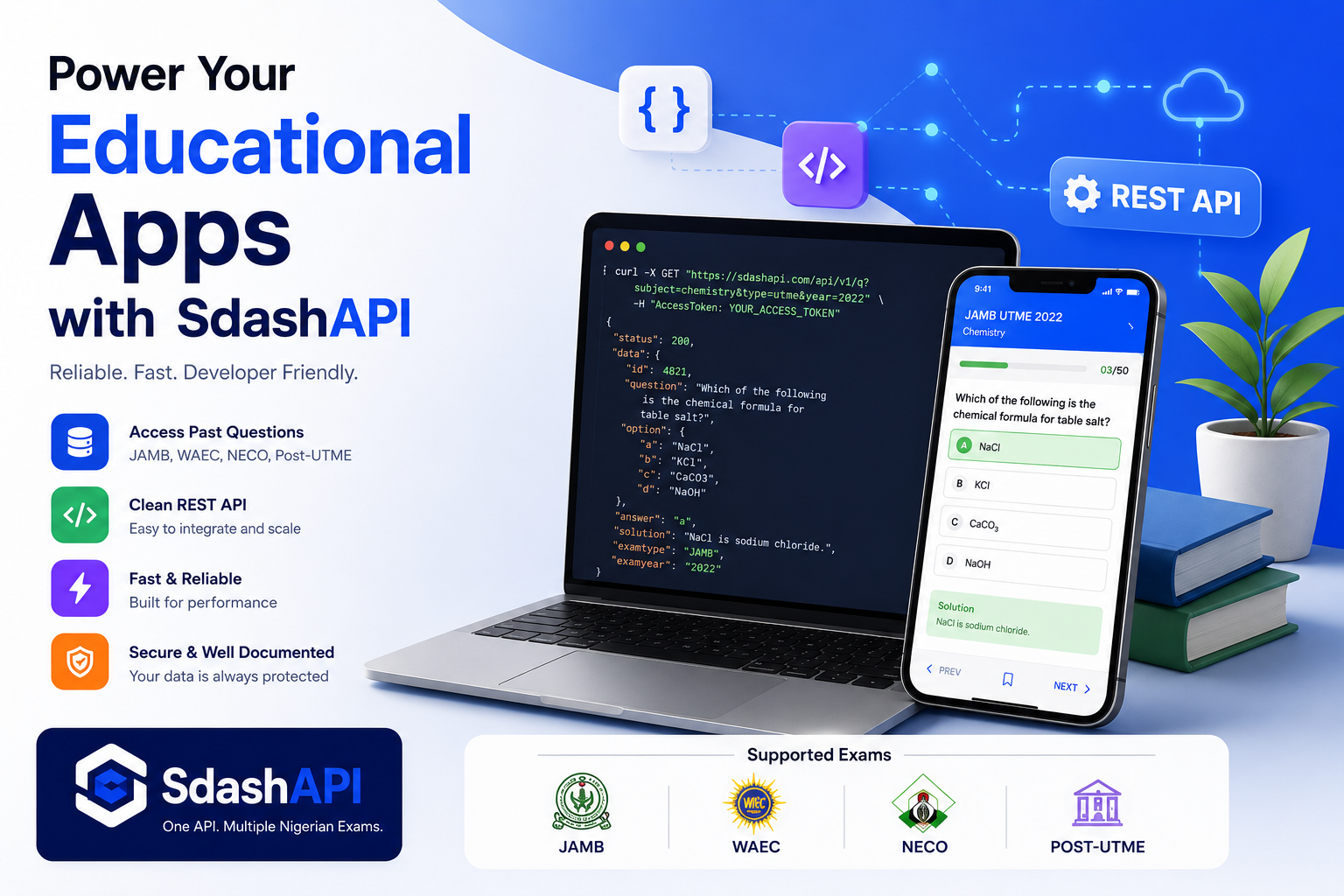
curl "https://sdashapi.com/api/v1/q?subject=chemistry&type=utme&year=2023" \
-H "AccessToken: YOUR_ACCESS_TOKEN"
Example Response
{
  "status": 200,
  "data": {
    "id": 4821,
    "question": "Which of the following is the chemical formula for table salt?",
    "option": {
      "a": "NaCl",
      "b": "KCl",
      "c": "CaCO3",
      "d": "NaOH"
    },
    "answer": "a",
    "solution": "NaCl is sodium chloride.",
    "examtype": "JAMB",
    "examyear": "2023"
  }
}
Explore More
If you're researching educational APIs, these resources may also help:
- JAMB API — Learn about SdashAPI's JAMB integration.
- WAEC API — Build WAEC revision and CBT platforms.
- Post-UTME API — Retrieve university screening questions.
- Nigerian Past Questions API — Explore all supported examinations.
- SdashAPI Documentation — Authentication, endpoints and code examples.
Frequently Asked Questions
Which API is easier to integrate?
Both provide REST APIs. Many developers value clear documentation, consistent JSON responses and straightforward authentication when choosing an API.
Does SdashAPI support multiple examinations?
Yes.
SdashAPI supports JAMB, WAEC, NECO and Post-UTME through a single REST API.
Can I use SdashAPI with React Native?
Yes.
SdashAPI works with React Native, Flutter, PHP, Laravel, Python, Node.js and other technologies capable of making HTTP requests.
Is SdashAPI suitable for production applications?
It is designed for developers building educational software, including CBT applications, school portals and student learning platforms.
Final Thoughts
There isn't a single API that's right for every project. The best choice depends on your application's requirements, the examinations you need, the documentation quality and the developer experience you're looking for.
If your goal is to build modern educational software using structured Nigerian examination data, SdashAPI provides a developer-focused REST API with support for JAMB, WAEC, NECO and Post-UTME.
Take some time to explore the SdashAPI documentation, review the JAMB API and WAEC API pages, and decide which platform best matches your project's needs.