Is SdashAPI Worth It? A Complete Review for Developers (2026)
When building an educational application, choosing the right API is an important decision.
Your API will power one of the most important parts of your platform—your examination content.
If the API is difficult to integrate, poorly documented or missing important features, you'll spend more time fixing problems than building your application.
This is why many developers take time to compare APIs before committing to one.
One question that comes up regularly is:
Is SdashAPI worth it?
The answer depends on what you're trying to build.
In this article, we'll look at what SdashAPI offers, the kind of projects it's designed for and whether it's a good fit for your next educational application.
What is SdashAPI?
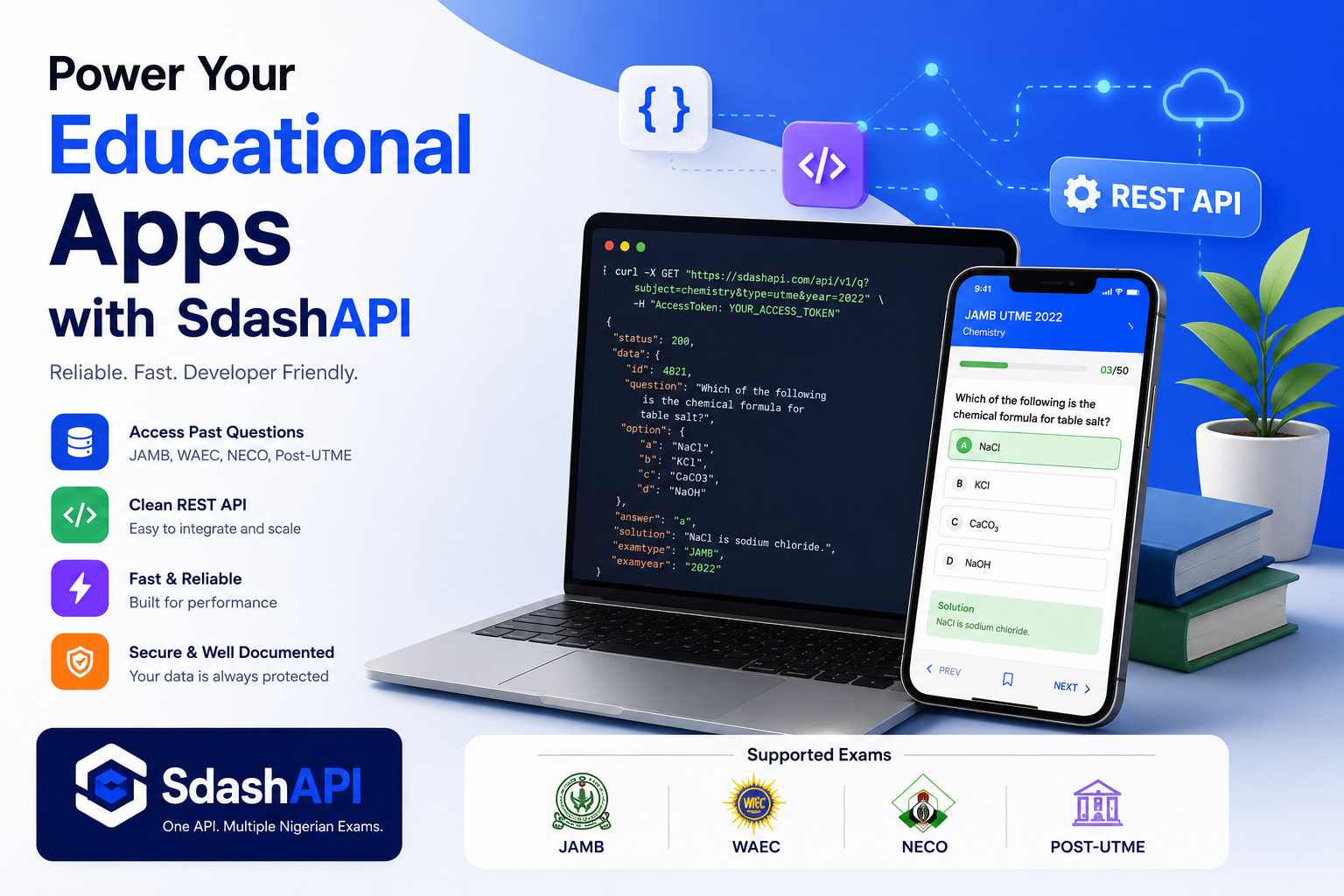
SdashAPI is a REST API that provides developers with structured access to Nigerian examination questions.
Instead of manually creating a large database of examination questions, your application retrieves the data through secure API requests.
SdashAPI currently supports:
- JAMB
- WAEC
- NECO
- Post-UTME
Developers receive structured JSON responses containing questions, answer options, correct answers and supported explanations.
To see all supported examination types, visit the Nigerian Past Questions API page.
Who Is SdashAPI Built For?
SdashAPI is designed for developers and organisations building educational software.
It is suitable for:
- Mobile app developers
- Educational startups
- Schools
- Universities
- Tutorial centres
- Online learning platforms
- AI educational tools
- Student revision websites
Whether you're creating your first CBT application or expanding an existing platform, SdashAPI provides a single API that supports multiple Nigerian examinations.
What Makes SdashAPI Useful?
There are several reasons developers choose an educational API instead of building a question database from scratch.
It Saves Development Time
Building a database of examination questions is one of the most time-consuming parts of creating a CBT application.
You need to:
- Collect questions
- Verify answers
- Organise subjects
- Separate examination years
- Format JSON
- Maintain the database
SdashAPI removes that work by providing ready-to-use examination data through a REST API.
One API for Multiple Examinations
Many educational applications begin with JAMB but later expand to support other examinations.
SdashAPI makes that easier by supporting:
- JAMB
- WAEC
- NECO
- Post-UTME
Developers don't need to integrate multiple APIs as their applications grow.
Developer-Friendly Documentation
Documentation plays a major role in the developer experience.
SdashAPI includes documentation covering:
- Authentication
- Endpoints
- Parameters
- Request examples
- Response examples
- Error handling
You can explore the documentation on the SdashAPI Documentation page.
Easy Integration
SdashAPI returns standard JSON responses and works with virtually every modern development framework.
It can be integrated with:
- React Native
- Flutter
- React
- Laravel
- PHP
- Node.js
- Python
- Java
If your application can send HTTP requests, it can use SdashAPI.
Structured Responses
One of the things developers appreciate is consistency.
Every endpoint follows a predictable response format, making frontend development much easier.
Instead of writing extra code to clean inconsistent data, developers can focus on building useful features.
What Can You Build with SdashAPI?
SdashAPI is flexible enough to support many different educational projects.
Some examples include:
- JAMB CBT applications
- WAEC practice platforms
- NECO revision apps
- University admission portals
- AI learning assistants
- Student revision websites
- School management systems
- Mock examination platforms
Because the API supports multiple examination types, the same integration can power several different products.
Example Request
curl "https://sdashapi.com/api/v1/q?subject=biology&type=utme&year=2023" \
-H "AccessToken: YOUR_ACCESS_TOKEN"
Example Response
{
  "status": 200,
  "data": {
    "id": 5104,
    "question": "Which organelle is known as the powerhouse of the cell?",
    "option": {
      "a": "Nucleus",
      "b": "Mitochondrion",
      "c": "Golgi Body",
      "d": "Ribosome"
    },
    "answer": "b",
    "solution": "The mitochondrion produces energy for the cell.",
    "examtype": "JAMB",
    "examyear": "2023"
  }
}
Is SdashAPI Right for Every Project?
No API is perfect for every situation.
If you're building a small personal project to learn how APIs work, you may not need every feature a production-ready educational API offers.
However, if you're creating an application that students will use regularly, you'll likely benefit from:
- Structured examination data
- Reliable documentation
- Support for multiple examinations
- Consistent response formats
- Easy integration
These are the kinds of features SdashAPI is designed to provide.
Helpful Resources
If you're interested in learning more, these pages are a good place to start:
- JAMB API — Learn how to retrieve JAMB questions.
- WAEC API — Access WAEC questions through a REST API.
- Post-UTME API — Build university screening platforms.
- Nigerian Past Questions API — Explore all supported examination APIs.
- SdashAPI Documentation — Authentication, endpoints and integration examples.
Frequently Asked Questions
Is SdashAPI free?
You can create an account and explore the platform. Production access depends on the plan you choose.
Can I use SdashAPI in a commercial application?
Yes.
Many developers use educational APIs when building commercial CBT platforms, school portals and learning applications.
Can I retrieve questions by subject and year?
Yes.
SdashAPI allows developers to filter requests using parameters such as subject, examination type and year.
Does SdashAPI support React Native?
Yes.
It works with React Native, Flutter, PHP, Laravel, Python, Node.js and other technologies that can make HTTP requests.
Final Thoughts
Whether SdashAPI is worth it depends on the kind of project you're building.
If your goal is to create a reliable educational application without spending months building and maintaining a question database, an API can significantly reduce development time.
SdashAPI provides structured access to JAMB, WAEC, NECO and Post-UTME questions through a developer-friendly REST API, making it easier to build educational software that can grow over time.
If you'd like to explore its features further, visit the Nigerian Past Questions API, browse the SdashAPI Documentation or learn more about the JAMB API before starting your next project.